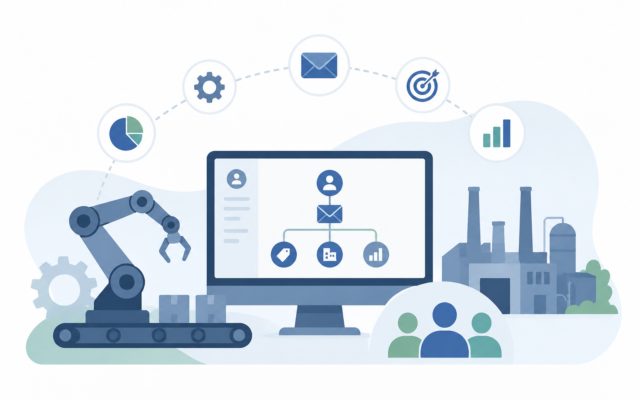
Marketing automation for manufacturing is the use of software to streamline lead generation, nurture prospects through long and technical sales cycles, and keep your sales and marketing teams pointed at the same revenue goal. In plain terms, it replaces the slow, manual, “batch and blast” outreach most manufacturers still rely on with personalized, behavior-triggered communication that runs in the background while your small team focuses on closing deals.
If you make industrial equipment, components, or custom products, you already know your buying journey looks nothing like a software trial or an online checkout. A single sale can take six to eighteen months, involve five or more stakeholders, and often depends on a distributor or rep firm you do not fully control. That is exactly the problem automation is built to solve. This playbook walks through what to automate, how to roll it out, which platforms fit, and how to prove the return.
Why it pays off
The business case is strong. Nucleus Research found that marketing automation returns an average of $5.44 for every $1 spent, with most companies recovering their investment in under six months. For a lean manufacturing team, that return comes from doing follow-up work at scale that you could never keep up with by hand.
What marketing automation for manufacturing actually means
At its core, marketing automation connects your website, email, and CRM so that the right message reaches the right buyer at the right moment, without anyone hitting “send” by hand.
For a manufacturer, that usually means three things working together.
Tracking behavior
You know exactly when a prospect views a spec sheet, downloads a CAD file, or revisits a product page.
Triggering follow-up
The system automatically sends a case study after a whitepaper download, or alerts a rep the moment a quiet account gets active again.
Scoring and routing leads
Your sales team spends time on the accounts that are genuinely ready, not on tire-kickers.
The goal is not to remove the human touch. It is to make sure no qualified lead goes cold during a sales cycle that may outlast several quarterly budgets.
Why manufacturing marketing is different from everyone else’s
Generic marketing advice falls apart in a plant. Here is what makes your situation unique, and why off-the-shelf “send more emails” tactics underperform.
Long, multi-touch sales cycles
Buyers research for months before they ever talk to a rep. Automation keeps you present across that whole window with education instead of pushy pitches.
Technical, multi-stakeholder buying committees
An engineer, a plant manager, a procurement lead, and a CFO all care about different things. Automation lets you send the engineer a technical spec, the CFO a total-cost-of-ownership breakdown, and procurement a supplier reliability story, all from one campaign.
Lean marketing teams
Many manufacturers run marketing with one or two people, sometimes a fraction of someone’s job. Automation is the force multiplier that makes a tiny team behave like a big one.
Distributor and channel networks
A huge share of manufacturing revenue flows through dealers, distributors, and rep firms. That is a layer most marketing tools ignore, and it is where the biggest, least-contested wins usually hide.
The use cases that actually move revenue
These are the workflows worth setting up first. Each one maps to a real manufacturing pain point.
1. Lead nurturing across long cycles
Automatically send targeted educational content (spec sheets, application guides, case studies) based on the exact product pages a prospect visits. You stay useful for months without manual effort.
2. Sales and CRM alignment
Route high-intent leads straight to the correct rep, and alert sales the moment a dormant account returns to your pricing or product page. No more leads dying in an inbox.
3. Lead scoring for technical buyers
Assign points for meaningful actions like downloading a CAD file or requesting a quote, so sales chases readiness, not noise.
4. Distributor and partner enablement
Push co-branded campaign templates, product launch kits, and shared analytics to your distributor network so partners can market consistently without building anything from scratch.
5. Post-purchase retention and reorders
Trigger reorder reminders, warranty renewal notices, maintenance schedules, and parts upsells automatically, turning one sale into a recurring relationship.
A practical first move: pick the single workflow tied to your biggest revenue leak (usually lead nurturing or sales alerts) and automate that before touching anything else. If you want help mapping these to your funnel, our marketing automation services team can build the first workflows with you.
A five-step plan to implement marketing automation in your manufacturing business
You do not need a six-month project to get value. Here is a realistic rollout.
Step 1: Define one clear goal
Decide whether you are generating new leads, supporting distributors, or upselling existing customers. One goal first. Everything else can wait.
Step 2: Clean up your data and connect your CRM
Automation built on a messy database just sends messy messages faster. Sync your CRM so behavior and sales activity live in one place.
Step 3: Map your buyer journey
Sketch the real path from “first website visit” to “signed order,” including the stages where deals stall. Those stall points are where your first workflows go.
Step 4: Build two or three core workflows
Start small. A welcome and education sequence, a sales alert for high-intent activity, and a re-engagement campaign for cold leads will cover most of the value.
Step 5: Measure, then expand
Track which workflows produce sales-qualified leads and pipeline, then add distributor enablement and retention campaigns once the basics prove out.
Best marketing automation platforms for manufacturers
The right tool depends on your team size, CRM, and how complex your sales cycle is. Here is an honest comparison of the platforms manufacturers reach for most.
| Platform | Best for | Strengths | Watch-outs |
|---|---|---|---|
| HubSpot | Lean teams wanting one connected system | Easy to learn, strong inbound and email tools, built-in CRM | Costs climb as your contact list grows |
| Act-On | B2B manufacturers with long, complex cycles | Strong behavioral tracking, lead scoring, account-based features | Smaller ecosystem than the giants |
| Salesforce (Account Engagement) | Enterprise manufacturers already on Salesforce | Deep CRM power and complex journey mapping | Heavier setup and a steeper learning curve |
| Zoho CRM | Budget-conscious teams wanting CRM plus automation | Affordable, flexible, lots of integrations | Less specialized for industrial use cases |
A simple rule: if you already use a CRM, choose the automation platform that integrates with it most cleanly. Switching CRMs to chase a marketing tool almost always costs more than it saves.
How to measure the ROI of marketing automation in manufacturing
Leadership will ask one question: is this paying for itself? Track these and you will have a clear answer.
- Marketing-qualified to sales-qualified lead rate. Are your automated workflows producing leads sales actually wants?
- Sales cycle length. Good nurturing shortens the time from first touch to closed order.
- Pipeline influenced by automation. Tag deals that passed through an automated workflow and total their value.
- Cost per qualified lead. This should fall as automation does work your team used to do by hand.
- Customer retention and reorder rate. Post-purchase workflows show up here.
On the efficiency side, Nucleus Research found that marketing automation drives a 14.5% increase in sales productivity and a 12.2% reduction in marketing overhead, which is exactly the kind of leverage a small manufacturing team needs.
Most manufacturers see the clearest early return from faster sales follow-up and recovered cold leads, because both turn activity you already paid for into revenue.
Common mistakes manufacturers make
- Automating a broken process. Fix your follow-up logic first, then automate it.
- Ignoring distributors. Your channel partners are the most overlooked automation opportunity in the industry.
- Over-emailing technical buyers. Engineers tune out fast. Lead with genuinely useful content, not promotions.
- Buying the biggest platform you can afford. Start with the workflows you will actually use. Capability you never configure is just expense.
Ready to put this into action?
You do not have to figure this out alone. If you want a clear, no-pressure assessment of where automation will move the needle fastest in your business, request a free consultation through our marketing automation services. Tell us your goal, your current CRM, and your team size, and we will send back a custom recommendation, including which workflows to build first and which platform fits your budget. You can also learn more about the team behind it before you decide.
Frequently asked questions
What is an example of automation in manufacturing marketing?
A common example is a triggered nurture sequence. When a prospect downloads a product spec sheet, the system automatically sends a related case study a few days later, then alerts a sales rep if the prospect returns to your pricing page. No one sends those messages by hand.
What are examples of marketing automation?
Typical examples include automated email nurture campaigns, lead scoring, website behavior tracking, abandoned-quote follow-ups, sales alerts for high-intent activity, and post-purchase reorder or warranty reminders.
What are the top marketing automation tools for manufacturers?
The most widely used options are HubSpot, Act-On, Salesforce Account Engagement, and Zoho CRM. HubSpot suits lean teams, Act-On fits complex B2B cycles, Salesforce serves enterprise needs, and Zoho works well on a tighter budget.
How do you automate your marketing process as a manufacturer?
Start by setting one clear goal, connecting your CRM, and mapping your buyer journey. Then build two or three core workflows, usually lead nurturing, sales alerts, and cold-lead re-engagement, before expanding into distributor enablement and customer retention.
How long before marketing automation shows results?
Quick wins from faster sales follow-up and recovered leads often appear within the first few weeks. Because manufacturing sales cycles are long, full pipeline and revenue impact usually become clear over one to two quarters.
Is marketing automation worth it for a small manufacturer?
Yes. Automation is most valuable for lean teams because it does the repetitive follow-up a small staff cannot keep up with manually, so even a modest setup tends to pay for itself.
The bottom line
Marketing automation for manufacturing is not about sending more email. It is about staying useful to technical buyers across long cycles, handing sales the right leads at the right moment, and finally giving your distributor network the marketing support it has always needed, all with a team that may be just one or two people. Pick one goal, automate one workflow, measure it, and grow from there. That is how lean manufacturing teams compete with companies many times their size.